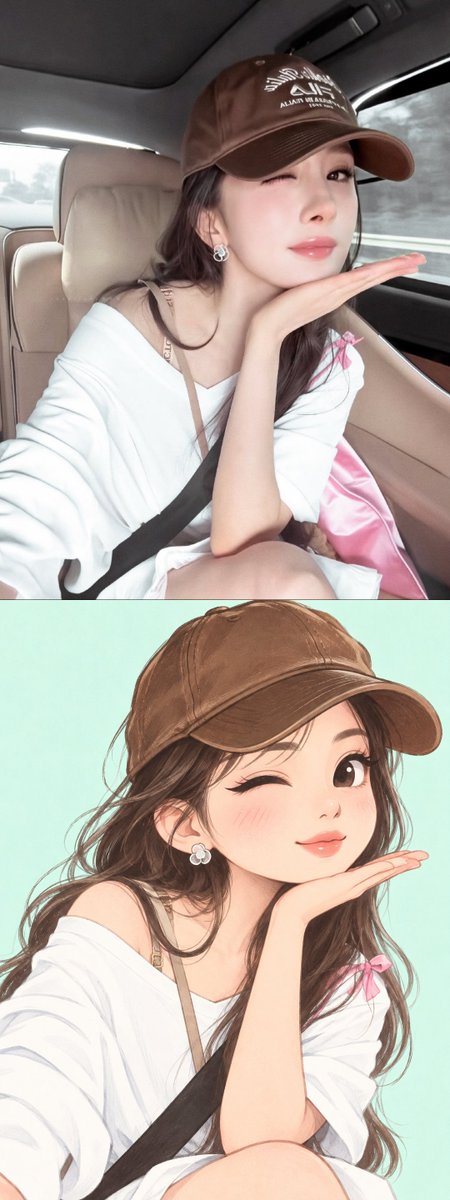
The uploaded photograph is the sole content source. Reimagine the person as a distinctly stylized, cute hand-drawn cartoon portrait on a plain pale mint background. Create a new illustrated character based on the person, with strong facial redesign and moderate likeness. The result must read immediately as a cartoon avatar, with clear simplified shapes and expressive proportions.

Actively redesign the head and face rather than preserving photographic geometry. Enlarge the head relative to the visible shoulders, broaden the upper face and cheeks, shorten the distance from the eyes to the chin, and replace the elongated photographic jaw with a compact rounded jaw and small gently tapered chin. Keep the source head tilt, viewing angle, gaze, and expression, but interpret them through this new cartoon construction. For a three-quarter view, use a simplified rounded three-quarter face with appropriate eye overlap and cheek contour, not a realistically modeled portrait.

Make the eyes prominent almond-shaped graphic forms with large dark brown or near-black irises occupying most of the visible opening, a small amount of off-white sclera, a confident dark upper eyelid, a few tapered lashes, and one small crisp highlight. Use simple flat iris colors without intricate radial detail. Match the source expression: preserve a wink, narrowed eyes, relaxed eyelids, or an open gaze rather than making every person wide-eyed. Draw eyebrows as distinct curved shapes with a few fine directional strokes.

Replace the realistic nose with a tiny curved mark, small nostril indication, or compact peach-colored shape. Omit the modeled nasal bridge, realistic nose projection, detailed nostril anatomy, and eye-socket shading. Shorten and simplify the mouth into a small expressive coral or muted rose shape. Preserve whether the lips are closed, parted, smiling, or pouting, while removing realistic lip texture and volumetric modeling. Use broad warm blush patches on the cheeks, optionally with a few short diagonal pencil marks.

Retain only the strongest identity anchors: the approximate face-shape impression after cartoon redesign, skin-tone family, hair color, hairstyle silhouette, parting, expression, age and gender presentation, and distinctive visible accessories. Preserve the source clothing categories, main colors, neckline, headwear, glasses, jewelry, and other existing personal items. Do not preserve exact facial measurements or photographic anatomy. Do not add accessories or replace the subject with a generic character.

Draw hair as a few large, clear dark shapes and overlapping curved locks. Add selective brown pencil highlights and a limited number of fine loose strands around the silhouette. Preserve braids, curls, tied hair, bangs, and their placement when present. Keep broad hair masses dominant; avoid covering the entire hairstyle with thousands of fine realistic strands.

Use slightly grainy dark brown pencil contours with natural variation in pressure, combined with broad matte gouache-like color fills. Keep skin mostly flat and warm, with only a few soft peach shadows beneath hair overlaps and the chin. Apply subtle paper grain across the illustration without making the texture dominate. Simplify clothing into broad shapes with sparse sketch lines and two or three muted shadow regions. The overall finish should be clean, soft, colorful, and visibly handmade.

Replace all scenery with a uniform pale mint or pastel aqua background. Preserve the source crop and visible body range, including head angle and shoulder direction. Adapt the enlarged head within the existing framing without inventing unseen body parts. Use a close portrait composition with the face and hair as the main focus.

Prioritize the redesigned cartoon face over precise likeness: rounded cheeks, shortened lower face, prominent dark eyes, tiny symbolic nose, small expressive mouth, organized hair masses, and restrained pencil texture. Avoid realistic colored-pencil portraiture, traced facial proportions, long anatomically modeled noses, deep eye sockets, skin pores, dense cross-hatching, realistic strand-by-strand hair, glossy rendering, 3D effects, extreme infant proportions, and elaborate backgrounds. Output one completed cartoon portrait only, with no original photograph, comparison layout, padding, text, interface elements, signature, or watermark.