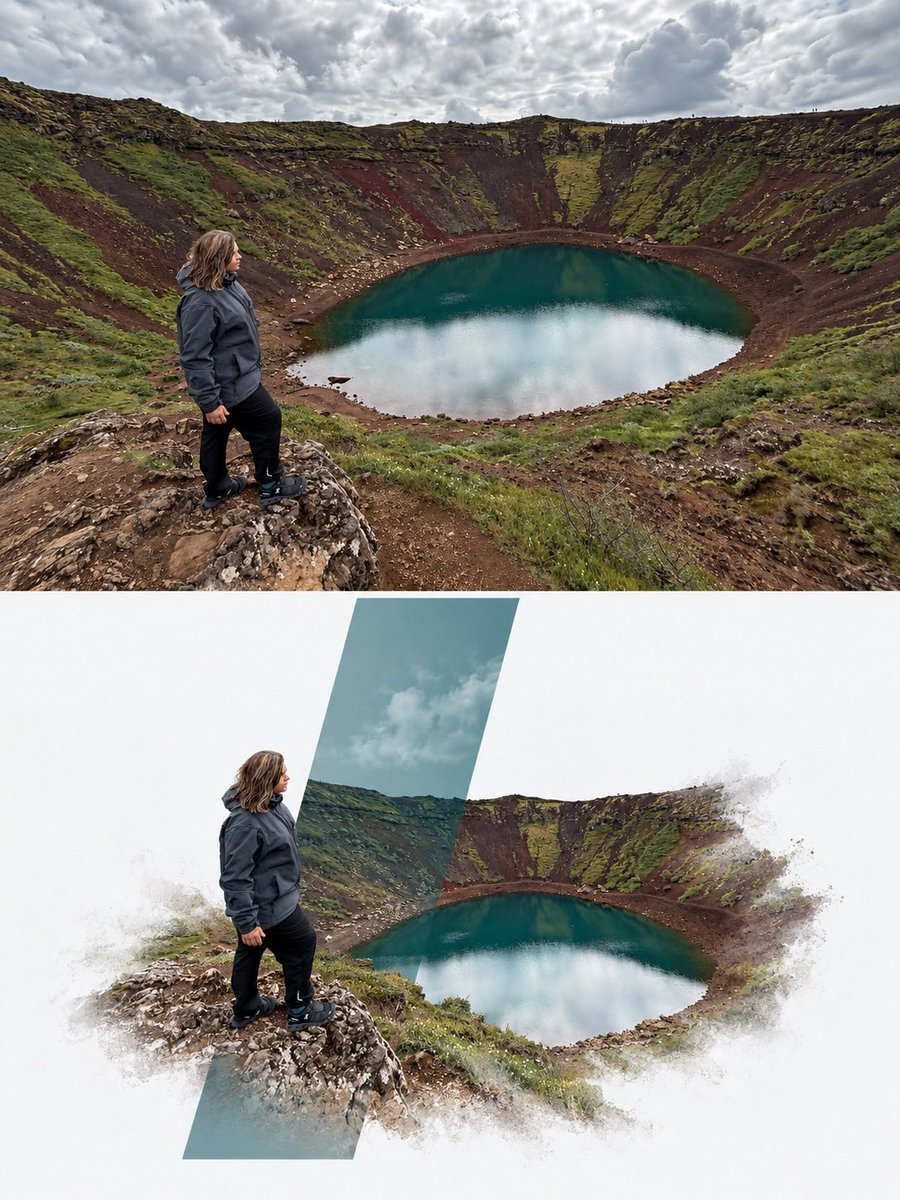
High-End Editorial-Style Poster Creation Guide
Each uploaded photograph must be turned into a separate high-end editorial-style poster. Multiple photographs must not be combined into a single composition.
The canvas must strictly follow a 3:4 vertical aspect ratio. It must be divided precisely along the horizontal centerline, with the upper and lower sections each occupying 50% of the total height. Both sections must maintain consistent dimensions and preserve the original proportions.
Upper Half: Original Photograph
The upper half must use the original photograph directly, without regenerating it.
All characteristics of the subject (person or architectural structure) must be fully preserved, including its features, proportions, perspective, spatial relationships, textures, natural lighting and shadows, colors, and environment.
Only minor cropping adjustments and restrained, high-end color grading are permitted.
The following are strictly prohibited:
Redrawing the subject
Adding artificial lighting effects
Applying HDR effects
Excessive saturation
Creating plastic-like textures
Introducing fictional or fabricated content
If adjustments are necessary to fit the canvas, only environmental areas such as the sky, water, ground, walls, vegetation, or background may be extended.
Lower Half: Narrative Reconstruction
The lower half must extract and reconstruct the photograph's "narrative core."
This may consist of a single subject or a group of related elements that communicate the photograph's defining characteristics, scale, movement, or narrative relationships.
The reconstructed elements must retain their realistic and recognizable appearance, proportions, internal structure, textures, and relative positions.
Important related elements must not be removed, and simple rectangular cutouts from the original photograph must not be used.
The reconstructed subject should typically occupy 55% to 80% of the lower section's width.
The subject should extend naturally along the photograph's primary directional flow, retaining appropriate ground surfaces, waterlines, shadows, or softly blended edges to integrate seamlessly into the background.
Avoid creating a sticker-like or floating appearance.
Geometric Window: Connecting Reality and Abstraction
Behind the subject, or passing through its center, incorporate a narrow, elongated, low-saturation geometric color block (color field).
This element serves as the "key window" connecting photographic reality with abstract editorial expression.
The color of this block must be sampled directly from the original photograph.
Its orientation—horizontal, vertical, or diagonal—should be determined by the overall narrative direction.
The subject must actively pass through the "window":
One portion of the subject should appear within the colored geometric area.
Another portion should extend into the surrounding open negative space.
The subject should naturally cross the window's boundaries, creating a sense of occlusion, penetration, and spatial depth.
The window must not resemble a simple frame or card-style design. Never enclose the entire subject within it.
Only one primary window may be used in the composition.
The following are strictly prohibited:
Multiple color blocks
Thick borders
Rounded corners
Strong gradient effects
Drop shadows
Lower Half: Background and Visual Hierarchy
The background of the lower half should be white, cool white, very light gray, or off-white, harmonizing with the style of the original photograph.
Use restrained asymmetrical composition and generous negative space to establish a three-layer visual hierarchy:
The reconstructed subject or narrative composition
The low-saturation geometric window