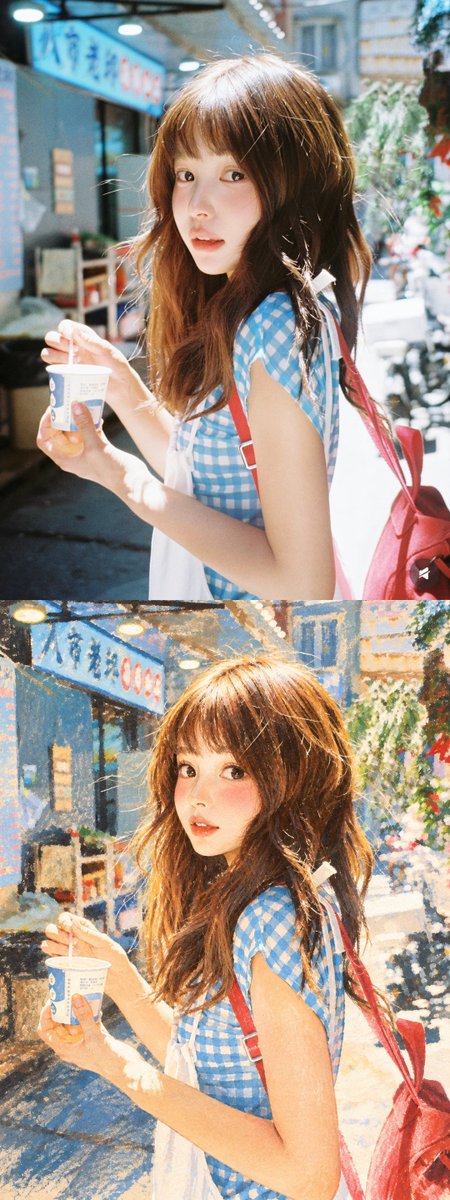
Use the uploaded photograph as the sole source for the subject, identity, pose, expression, clothing, accessories, important objects, camera angle, framing, location, season, weather, lighting, and narrative theme.

Transform the entire photograph into one standalone contemporary picture-book lifestyle illustration on warm textured paper. Output only the completed illustration—not the source photograph, not a before-and-after comparison, not a top-and-bottom layout, not a split screen, and not a collage.

Preserve the source image’s camera viewpoint and composition. If the photograph uses a high angle, low angle, close-up, overhead view, or unusual perspective, retain that perspective and its foreshortening. Preserve the original visible body range and crop. Do not zoom out, expand the scene, or invent body parts outside the photograph.

Preserve the main subject’s recognizable identity anchors: hairstyle silhouette, hair length and color, approximate face shape, apparent age, expression category, gaze direction, clothing categories, dominant garment colors, visible patterns, footwear, bag, glasses, jewelry, hat, hood, and other distinctive accessories. Preserve the original pose, hand gesture, arm position, leg position, body orientation, and interaction with the environment.

Redesign the person as a charming contemporary picture-book character with moderate stylization. Use a softly simplified face, expressive but not excessively enlarged eyes, delicate eyebrows, a small simplified nose, a clearly readable mouth, warm rosy cheeks, and graceful facial contours. Preserve enough hairstyle, face-shape, expression, and accessory information for the character to remain recognizably connected to the source person.

Do not trace the photograph mechanically. Simplify and reorganize facial details into a coherent illustrated language while preserving the original emotional tone. A smile, wink, pout, serious expression, surprise, or other distinctive expression must remain recognizable.

Render the hair with flowing groups of fine ink, colored-pencil, and dry-pastel strokes. Preserve its approximate length, curl pattern, parting, volume, direction, and movement. Avoid both photorealistic individual strands and a flat plastic hair shape.

Render clothing and accessories with broad matte color regions, loose sketch lines, dry-brush edges, and visible colored-pencil or oil-pastel texture. Preserve the major garment layers, silhouettes, color relationships, recognizable patterns, bag placement, footwear, and important accessories. Simplify minor seams and hardware without replacing the outfit.

Medium and surface:
combine matte gouache, oil pastel, wax crayon, colored pencil, dry ink, and distressed screen-print texture. Use slightly broken contours, uneven pigment coverage, visible paper grain, scattered speckles, rubbed edges, subtle print misregistration, dry-brush gaps, and handmade irregularity. The result should look drawn and printed on fibrous paper rather than digitally airbrushed.

Derive the palette from the uploaded photograph. Preserve its dominant colors and emotional temperature, then translate them into a slightly muted, warm, print-friendly palette. Do not impose autumn orange, yellow leaves, dark pavement, or any other seasonal palette unless those elements are supported by the source image.

Infer the environmental theme exclusively from the source:
- spring scenes may use fresh greens, blossoms, pale sunlight, and airy decorative marks;
- summer scenes may use clear blues, bright vegetation, warm light, water, or lively saturated accents;
- autumn scenes may use ochre, rust, dry leaves, and warm dark ground;
- winter scenes may use cool gray-blue, snow, bare branches, knit textures, and soft indoor light;
- indoor scenes should preserve their actual domestic, café, office, bedroom, or studio atmosphere;
- urban, seaside, forest, travel, celebration, and everyday-life scenes should retain their own recognizable contextual motifs.

These examples are conditional, not mandatory. Never change the source season, location, weather, or activity merely to fit a predetermined theme.

Simplify the environment into large readable graphic shapes while retaining the scene-defining elements needed to understand the location and action. Translate existing plants, flowers, snow, water, clouds, architecture, furniture, street markings, seasonal objects, or ground textures into the same handmade illustration language. Remove irrelevant photographic clutter.

Use decorative motifs only when they are already present or logically supported by the source environment. For example, use leaves for a leafy street, flowers for a garden, waves for a seaside scene, snowflakes for a snowy setting, stars for a nighttime scene, or small household motifs for an indoor memory. Do not add autumn leaves to unrelated scenes.

Keep the main subject as the clear focal point, occupying approximately the same visual importance as in the source. Create contrast using the source-derived background colors rather than automatically using a black background. Background shapes may be dark or light depending on what best preserves the original atmosphere and separates the subject.

Optional companion-animal module:
Preserve an animal if one is already present in the source. Add a new small companion animal only when the user explicitly requests one. Render it in the same gouache, pastel, and printed-paper style. Do not insert a default cat.

Optional typography module:
Add lettering only when the user supplies exact text.

Main title:
[MAIN TITLE]

Small note 1:
[SMALL NOTE 1]

Small note 2:
[SMALL NOTE 2]

Render the main title as loose hand-painted lettering with naturally uneven strokes. Render secondary notes as smaller handwritten text. Choose lettering colors from the image palette so they remain readable but secondary to the subject. Add no more than two small hearts, underlines, stars, leaves, flowers, or similar marks, and only when they match the source theme.

Use only the exact supplied wording. Do not infer the season from the title, translate the text, rewrite it, or invent captions. If no wording is supplied, omit all typography.

Finish the artwork with a subtly distressed printed-paper treatment: worn pigment, scattered grain, small flecks, dry-brushed transitions, and naturally broken marks near portions of the perimeter. This should feel like handmade printing on paper, not a picture frame, Polaroid, torn-paper collage, or decorative border.

Overall aesthetic:
a warm contemporary picture-book lifestyle illustration, editorial memory poster, matte gouache, colored pencil, oil pastel, distressed screen printing, tactile paper grain, expressive character drawing, source-derived colors, handmade warmth, and moderate visual sweetness.

Avoid: retaining photographic regions, comparison layouts, fixed autumn styling, automatic orange leaves, changing the source season, changing the location, changing the weather, pasted photo faces, photorealistic skin, smooth digital gradients, glossy 3D rendering, clean vector art, extreme chibi proportions, giant sparkling eyes, generic replacement faces, changed hairstyle, changed outfit, changed pose, invented limbs, expanded framing, random animals, unrelated decorations, excessive environmental motifs, invented text, fake signatures, logos, social-media marks, or watermarks.

Replace the entire uploaded photograph with the illustrated artwork. Return exactly one full-frame illustration. Do not display, reproduce, embed, or retain the source photograph anywhere in the final output.